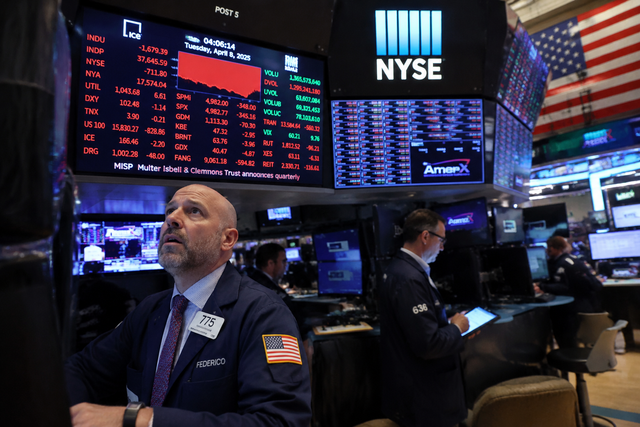
Wall Street closed sharply lower on Monday as technology and consumer discretionary stocks led a broad selloff that erased gains from the prior week's rally. The Nasdaq Composite fell more than 1.5%, its worst single-session decline in three weeks, as investors rotated out of high-valuation growth stocks amid rising concerns about the sustainability of the AI spending boom.
The Dow Jones Industrial Average dropped 432 points, or 0.8%, to close below 53,000, while the S&P 500 fell 1.1%. The tech-heavy Nasdaq bore the brunt of the selling, declining 1.6% as megacap technology stocks that had powered the market higher for much of the year came under pressure.
Intel shares fell nearly 10% after the chipmaker issued a cautious outlook for the second half of 2026, citing uncertainty around AI chip demand and ongoing challenges in its foundry business. Astera Labs, a high-flying AI infrastructure stock, dropped 11.5%, while Marvell Technology declined 7.5%. The Philadelphia Semiconductor Index fell more than 3%, its worst session since mid-June.
"The market had priced in perfection and got something close to it — which wasn't enough," said one senior portfolio manager at a New York-based hedge fund. "When a stock is up 400% in a year, even a small miss on margin trajectory can trigger a cascading selloff."
Consumer discretionary stocks also weighed on the indices. Amazon fell 2.3% after reports that the company's Prime Day sales growth had slowed compared to the prior year. Tesla dropped 3.1% as analysts questioned whether the electric vehicle maker's recent price cuts would be sufficient to maintain market share against increasingly competitive Chinese rivals.
The selloff came despite a weaker-than-expected June jobs report that would normally be interpreted as supportive for equities, given its implications for Federal Reserve rate cuts. The disconnect suggests that investors are more focused on earnings expectations and valuation levels than on macroeconomic tailwinds.
Beneath the surface, market breadth was notably poor. Declining stocks outnumbered advancing ones by a ratio of nearly 3-to-1 on the New York Stock Exchange, and more than 400 S&P 500 constituents finished in the red. The VIX, Wall Street's so-called fear gauge, jumped 12% to 18.5, its highest close in two weeks.
The bond market told a different story. The yield on the 10-year U.S. Treasury fell 6 basis points to 4.12% as investors sought safety and traders priced in a greater probability of a September rate cut. Fed funds futures now imply a 78% chance of a 25-basis-point cut at the September meeting, up from 65% before the jobs data.
"This is a market that's looking for a reason to sell," said David Rosenberg, founder of Rosenberg Research. "The AI trade has been the only game in town for two years, and any crack in that narrative is going to cause these kinds of moves. The question is whether this is a healthy correction or the start of something bigger."
Overseas markets provided little comfort. European indices closed broadly lower, with the Stoxx 600 down 0.7%, while Asian markets were mixed overnight. Investors will be watching Wednesday's release of minutes from the Fed's June meeting for further clues on the central bank's policy trajectory.
Image source: i.ibb.co