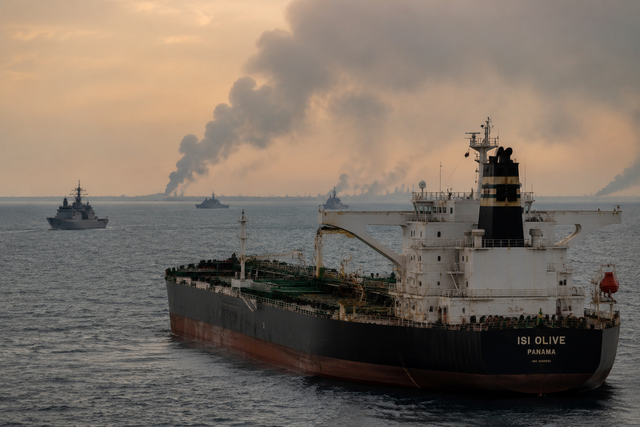
Oil prices surged more than 3% on Monday after Iran attacked commercial tankers transiting the Strait of Hormuz, prompting the United States to revoke its authorization for Iranian oil sales and resume military strikes against Tehran. The escalation sent Brent crude above $72 a barrel and raised fears of a broader disruption to global energy supplies.
The U.S. Central Command confirmed that American forces carried out "powerful strikes" on Iranian targets after vessels operating under the U.S. Navy's protected transit route through the Strait of Hormuz were attacked by Iranian forces. The strait, a narrow waterway between Iran and Oman, handles roughly 20% of the world's daily oil supply and is considered the most critical chokepoint in global energy logistics.
In response to the attacks, the U.S. Treasury revoked a sanctions waiver that had previously allowed limited sales of Iranian oil on international markets. The waiver, originally issued as part of ongoing diplomatic negotiations, had permitted certain volumes of Iranian crude to reach buyers in Asia. Its revocation effectively tightens the global oil supply at a time when demand remains strong heading into the Northern Hemisphere summer driving season.
"This is a significant escalation," said Helima Croft, head of global commodity strategy at RBC Capital Markets. "The combination of kinetic military action and sanctions reimposition could remove up to 1.5 million barrels per day from the market if enforcement is strict."
West Texas Intermediate (WTI) crude rose $2.21 to $72.65 per barrel, while Brent crude climbed above $75. The move rippled through equity markets, with energy stocks rallying — Occidental Petroleum gained nearly 6% and Devon Energy rose 5% — while the broader market declined on concerns that higher energy costs could reignite inflationary pressures.
The threat level for the Strait of Hormuz was raised to "severe" by maritime security authorities, meaning that all vessels transiting the waterway face an elevated risk of attack. Insurance costs for tankers operating in the region have spiked, with some underwriters reportedly refusing coverage for vessels without military escort.
European allies scrambled to respond. The United Kingdom and France announced a joint agreement with Oman to help ensure the safety of Omani territorial waters adjacent to the strait. NATO leaders, gathered in Turkey for the alliance's annual summit, were expected to discuss a coordinated naval response.
For consumers, the immediate impact is likely to be felt at the gas pump. Analysts at JPMorgan estimated that a sustained $10-per-barrel increase in crude prices would add roughly 25 cents to the average U.S. gasoline price within four to six weeks. With the national average already at $3.65 per gallon, a move above $4 would mark the highest level since the summer of 2022.
The situation remains fluid. Diplomatic channels have not been fully closed, and several nations — including China and India, the largest buyers of Iranian crude — have called for restraint. But with military operations ongoing and sanctions tightening, the oil market is pricing in the risk of a prolonged disruption that could reshape the global energy outlook for the remainder of 2026.
Image source: i.ibb.co