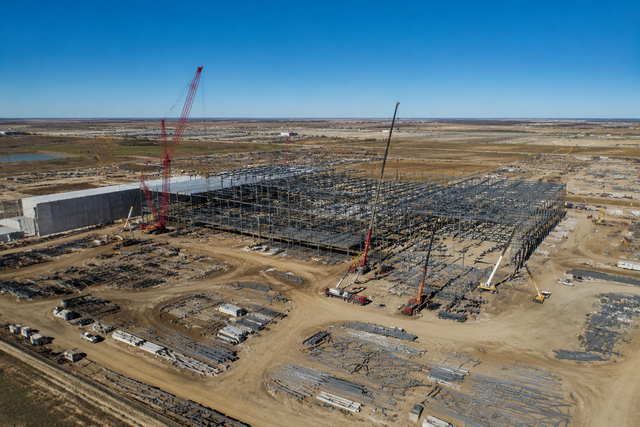
Meta Platforms has committed C$13 billion to build its first Canadian data center in Sturgeon County, Alberta, a sprawling 1-gigawatt facility that represents one of the largest single foreign technology investments in the country's history. The project underscores Alberta's aggressive push to position itself as a North American hub for artificial intelligence infrastructure.
The announcement, confirmed by Meta on Tuesday, will see the social media giant construct a hyperscale data center campus roughly 30 kilometers north of Edmonton. At full build-out, the facility will span more than 2.8 million square feet and house the computational infrastructure needed to train and run Meta's next generation of AI models, including its Llama family of large language models.
Alberta Premier Danielle Smith has made attracting data center investment a centerpiece of her economic diversification strategy. The province has set an ambitious target of drawing C$100 billion in data center investment by 2030, leveraging its abundant natural gas supplies for cheap electricity and its cold climate to reduce cooling costs — two factors that make it increasingly attractive to power-hungry AI operations.
"This is a generational investment," said one senior Alberta government official who spoke on condition of anonymity. "Meta's commitment validates everything we've been saying about Alberta's competitive advantages for AI infrastructure."
The Meta facility will be the company's 33rd data center globally and its largest outside the United States. Construction is expected to create more than 2,000 direct jobs over the next four years, with the facility eventually employing approximately 500 permanent staff once operational.
The investment comes as technology companies race to build out AI computing capacity at an unprecedented pace. Meta has raised its capital expenditure forecast for 2026 to as much as $72 billion, while Microsoft, Google, and Amazon have collectively committed hundreds of billions more. The insatiable demand for AI training and inference compute has turned data center construction into one of the fastest-growing segments of the global economy.
For Alberta, the deal represents a significant win in a competitive landscape where U.S. states, European countries, and other Canadian provinces have all been courting the same pool of technology investors. The province's pitch — cheap energy, cold weather, stable governance, and proximity to trans-Pacific fiber optic cables — appears to be gaining traction. Dozens of additional AI data center projects are reportedly in various stages of development across the region.
Critics have raised concerns about the environmental footprint of such massive facilities, though Meta has pledged to power the site with 100% renewable energy through a combination of power purchase agreements and on-site generation. The company has also committed to water-positive operations by 2030, a target that will be closely watched given Alberta's semi-arid climate in certain regions.
Construction is slated to begin in the first quarter of 2027, with the first phase expected to come online by late 2028.
Image source: i.ibb.co