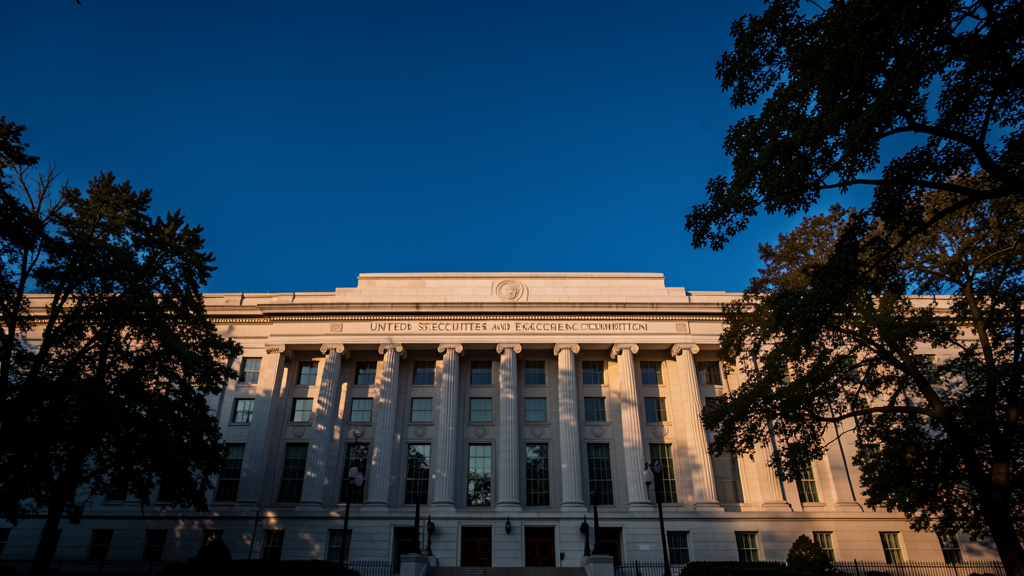
The U.S. Securities and Exchange Commission has now approved spot-based crypto exchange-traded funds tied to Bitcoin, Ethereum, Solana, XRP, and Dogecoin, with roughly 16 additional applications awaiting final ruling by October 2026. The event represents the most significant broadening of regulated crypto access in the United States since the original Bitcoin and Ethereum spot ETF approvals in early 2024 — and it is arriving in an environment that looks very different from the hype-driven launch that preceded it.
So far, the products have proven less transformative than their pre-approval marketing suggested. Bitcoin ETFs did bring in large institutional inflows at launch, but they also introduced a two-way exit ramp that did not previously exist in any crypto vehicle. The May-June 2026 outflow streak described elsewhere on this blog — $4.4 billion leaving U.S. spot Bitcoin ETFs over 13 days — is a direct consequence of ETF structure, not a failure of the product. ETFs give holders the same right to sell that they give to equity owners. That is the tradeoff required for institutional access on Wall Street's terms.
The approval wave is not merely a regulatory formality. It reflects a genuine recalibration by the SEC under a different political and judicial environment. Courts have increasingly sided with issuers in crypto ETF cases. The SEC's April 2026 proposal to raise the asset eligibility threshold to 85 percent signals an attempt to set a higher bar for future applicants, suggesting the agency views the approvals already granted as the outer edge of what it is prepared to allow without legislative guidance. The rule change, if finalized, would lock out smaller altcoins from ETF access and consolidate institutional crypto exposure around a narrow set of liquid, regulated tokens.
The timeline for the remaining 16 applications has broad public significance. Analysts at CoinTelegraph and other outlets reported that the SEC has asked multiple issuers to withdraw 19b-4 filing forms in preparation for final decisions, and that deadline windows stretch to October 2026. Most market observers expect the approvals to clear by that date, with Solana and XRP-based multi-asset products among the most anticipated launches. Grayscale has already filed for a blended Bitcoin-and-Ethereum product tracked on NYSE Arca, adding another vector of institutional access that did not exist six months ago.
BlackRock's June 2026 launch of a volatility-linked Bitcoin ETF, BITA, adds a new product category to the mix. The fund lets institutions earn from Bitcoin price swings through a structured product mechanism, with explicit caveats about complexity embedded in its marketing. The launch is a signal that product innovation is moving beyond simple spot-price tracking toward the sophisticated structured-exposure strategies common in traditional equity and commodity markets.
The SEC's approval trajectory has reshaped crypto's capital markets infrastructure without resolving the regulation-versus-legislation question hanging over digital assets. Congressional efforts to create a comprehensive federal framework for crypto have stalled repeatedly in the Senate, and the SEC's approach remains grounded in existing securities law rather than a digital-asset-specific regime. That inconsistency is a risk for issuers who will now operate under a patchwork of enforcement discretion, judicial precedent, and agency rulemaking rather than a clear statutory rulebook.
For individual investors, the entry point for regulated crypto exposure has never been broader. Traditional brokerage accounts now offer Bitcoin and Ethereum ETFs alongside equity and bond funds, and the incoming wave of products will deepen that menu. The tradeoff is that the VeChain, smaller-cap altcoin ecosystem, and the decentralized finance infrastructure built on Ethereum are not being democratized by ETFs — they are being sidelined by a higher regulatory standard that favors the most capital-intensive, well-capitalized tokens. The road to Wall Street's acceptance runs through a narrower gate than crypto maximalists would prefer.
Image source: v3b.fal.media