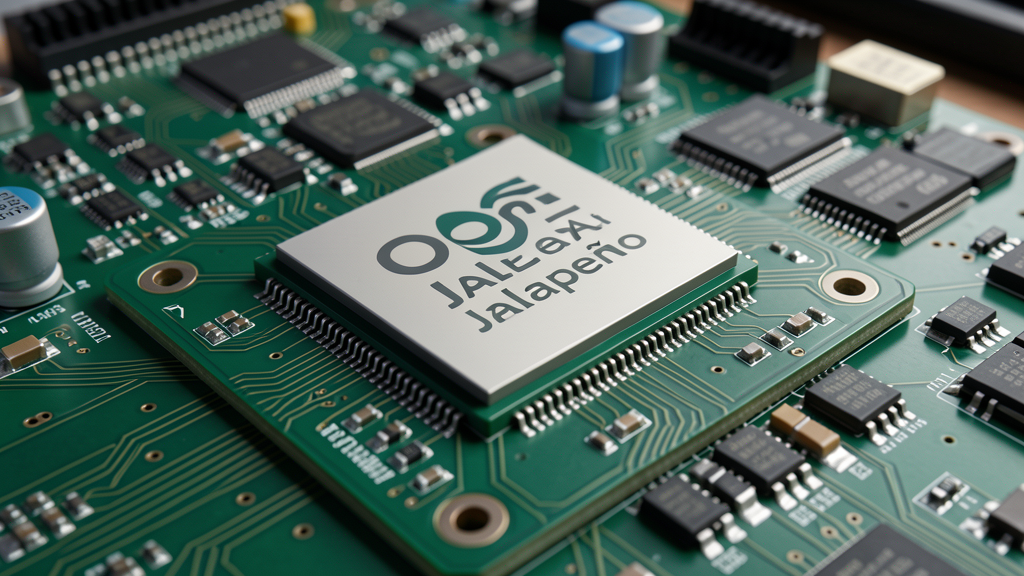
OpenAI has designed its first custom artificial-intelligence chip, ending years of near-total reliance on third-party hardware and marking a significant step in the race to control the full stack of AI infrastructure.
The chip, named Jalapeño, is an application-specific accelerator built in partnership with Broadcom to handle inference—the computationally intensive process of serving AI models to end users. OpenAI executives said engineering samples are already running workloads in laboratory settings, with initial deployment targeted for late 2026 and production ramping through 2027 and 2028.
The development highlights a broader industry shift toward custom silicon. Google, Amazon and Meta have pursued similar paths, but OpenAI's decision to build rather than buy carries particular weight because the company is also one of the world's largest consumers of Nvidia graphics processors. By designing its own inference engine, OpenAI aims to lower the cost of serving models such as ChatGPT and Codex while improving speed and energy efficiency.
According to OpenAI, Jalapeño was architected from a blank-slate design optimized specifically for large language models, rather than being engineered as a general-purpose accelerator retrofitted for AI tasks. The company said early testing shows the chip delivers “performance per watt substantially better than current state-of-the-art.” Integration of Broadcom's Tomahawk networking silicon was intended to support large-scale data-center deployment.
The move also reflects OpenAI's “full-stack” strategy, in which the company seeks control over models, products and infrastructure simultaneously. Greg Brockman, OpenAI's president, described the approach as a “flywheel” in which better hardware enables more capable models, which in turn generate revenue to reinvest in the next generation of compute. Hock Tan, Broadcom's president and CEO, said compute demand from AI customers remains “insatiable” and emphasized that the collaboration is expected to span multiple chip generations.
Analysts noted that the announcement places additional competitive pressure on Nvidia, whose GPUs currently dominate AI training and inference markets. Custom AI chip sales are projected to grow roughly 45% in 2026, outpacing GPU shipment growth of about 16%, according to industry estimates. Broadcom's stock has risen roughly 10% this year, reflecting sustained investor confidence in the custom-silicon trend.
Image source: v3b.fal.media