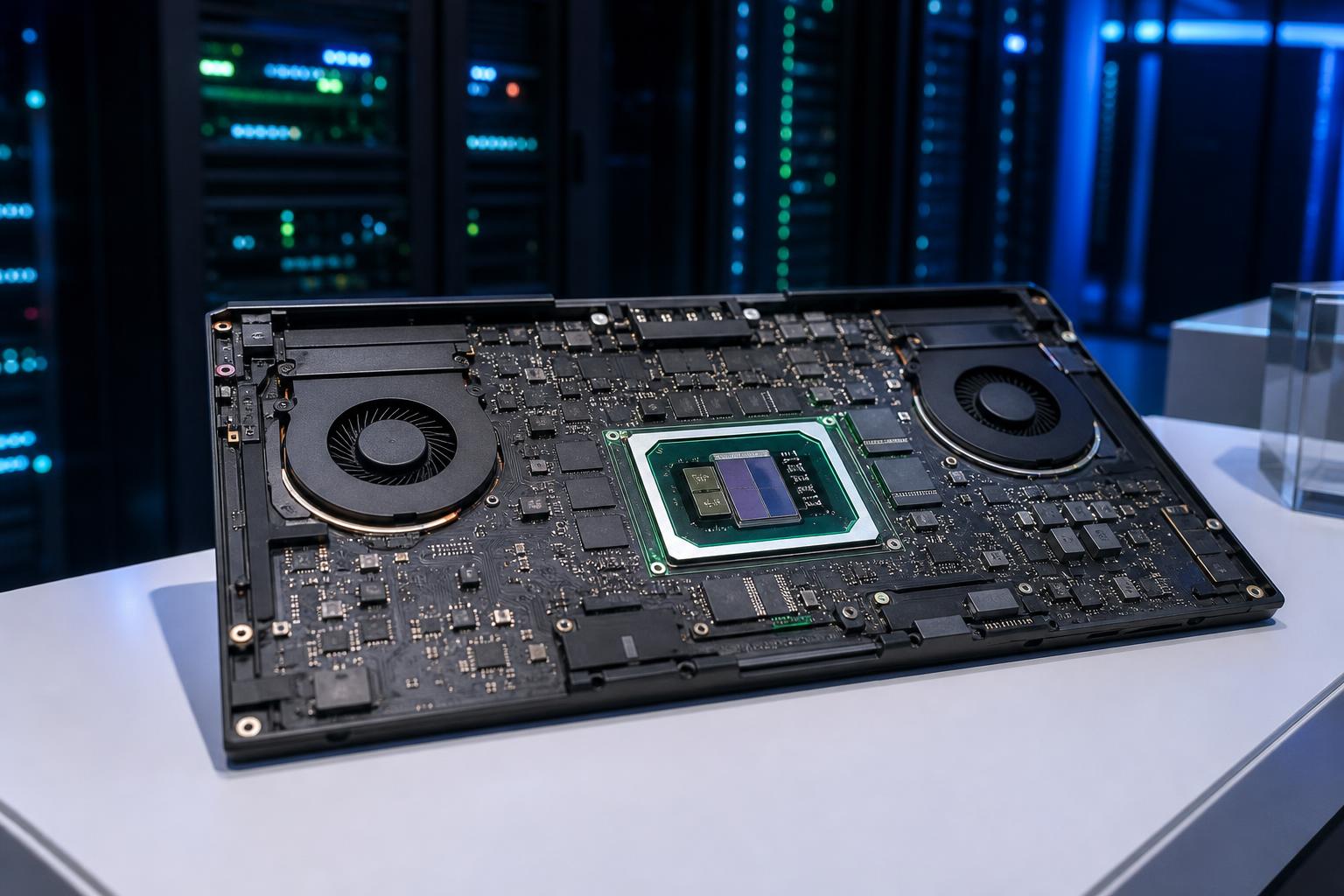
Nvidia’s newest chip announcement is not just another turn in the semiconductor cycle. It is a signal that the AI build-out is beginning to move from giant cloud clusters toward the devices people use every day.
At Computex in Taipei, Nvidia unveiled a new chip designed to bring advanced artificial intelligence capabilities directly into laptops and desktop computers. The move puts the company into a more direct contest with Apple, Intel, AMD and Qualcomm, while extending its reach beyond the data center business that has powered one of the most extraordinary growth stories in global markets.
Chief Executive Jensen Huang framed the launch around a future of autonomous agents, where software does not merely answer questions but carries out tasks on behalf of users. Reuters reported that early adopters of Nvidia’s Vera central processor include OpenAI, Anthropic and SpaceX, a group that underlines how closely the AI hardware race is tied to frontier model developers.
The strategic question is whether enough AI work can shift onto local machines to change the economics of inference. Today, most demanding AI workloads still run through cloud data centers. But as models become more efficient and enterprises worry about latency, cost and data control, chipmakers are betting that PCs and workstations will become part of the AI infrastructure stack.
Nvidia’s scale gives it an advantage. The company recently reported record quarterly revenue of $81.6 billion, with data center revenue of $75.2 billion, showing how much demand remains concentrated in centralized computing. Yet its own financial disclosures also point to edge computing as a growth category for agentic and physical AI.
That makes the PC push less of a detour and more of a second front. If AI agents become persistent workplace tools, the winning architecture may not be cloud-only. It may be a hybrid system in which local processors handle routine or privacy-sensitive tasks while large data centers remain the backbone for the heaviest workloads.
The competition will be intense. Apple controls its own silicon and operating system, Qualcomm has been pushing Arm-based AI PCs, and Intel and AMD are fighting to keep the personal computer central to enterprise IT. Nvidia is entering that arena with the credibility of the AI boom behind it, but also with expectations that leave little room for disappointment.
For investors and technology buyers, the launch is a reminder that the AI cycle is broadening. The first phase was about building enough data center capacity. The next may be about deciding where intelligence actually runs.
Image source: i.ibb.co