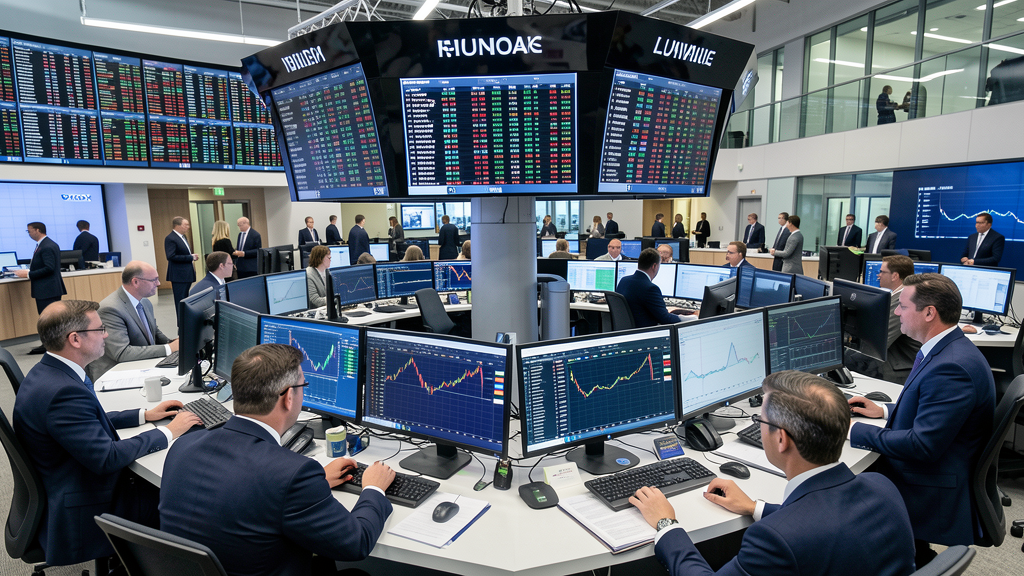
The S&P 500 closed near its highest level of the year on June 15, rising 1.65% to 7,554.29, while the Nasdaq Composite climbed 3.07% to 26,683.94 for its best single-session performance in months. The milestone capped a week of inflows so large that fund managers described it as the strongest period of institutional buying into U.S. technology equities since the artificial-intelligence rally began in earnest in late 2023.
By June 22, the S&P 500 was trading around 7,476, a modest pullback from the earlier record but still within striking distance. The broader context is a market that has absorbed an unusual volume of conflicting signals in the first half of 2026 — a U.S.-Iran war that sent oil prices rocketing, aggressive Federal Reserve rate policy, and a technology sector whose earnings power has become harder for traditional valuation models to capture.
The strongest single catalyst through mid-June was the partial de-escalation in U.S.-Iran relations. The framework agreement announced on June 17 and subsequent talks in Islamabad that produced a formal roadmap on June 21 pushed Brent crude back toward $79 a barrel, relieving pressure on sectors that are sensitive to energy costs, from airlines to consumer goods manufacturers.
Technology remained the dominant force in the rally. The Nasdaq's outperformance relative to the broader S&P reflects two things: the continued gravitational pull of a small group of companies with outsized weightings — firms whose earnings are substantially influenced by AI investment — and the fact that rate sensitivity, which had punished tech stocks through 2024 and much of 2025, is diminishing as investors grow more confident that the Federal Reserve is near the end of its tightening cycle.
Federal Reserve Chairman Kevin Warsh made his debut on the policy stage at the FOMC press conference on June 17, 2026, reflecting a leadership change at the central bank that investors have been watching closely. Warsh's predecessors had presided over a period of sustained monetary restraint, and the markets' constructive response to the June statement suggests investors are attributing a modestly more flexible bias to the new chairman.
Asian markets have been broadly sympathetic to the U.S. tone. The MSCI Asia Pacific Index rose 0.6% on June 21 as technology shares in the region rallied on the coattails of their U.S. counterparts. Yen weakness and inexpensive Korean valuations helped support Nikkei and Kospi records, respectively. China's domestic indices have been more muted, reflecting concerns about domestic demand and property-sector leverage that have yet to fully resolve.
One of the more quietly notable trends has been the emergence of so-called thematic ETFs tracking AI-linked semiconductor and infrastructure plays. Bloomberg reported on June 19 that several such funds had drawn record weekly inflows, indicating that retail and institutional participants are treating AI exposure as a distinct macro trade rather than a stock-picking exercise.
Economists at Oxford Economics noted that the timing of the Iran framework is fortunate for markets: "The major central bank policy meetings have now passed, reducing a key source of uncertainty." That window of calm, however, will likely be tested again as the U.S. election cycle intensifies and as the Federal Reserve's next moves become clearer. The S&P 500's current level embeds expectations that the Fed will ease into 2027 without triggering a wider deterioration in credit conditions.
Bonds have been less enthusiastic. U.S. Treasuries fell across the curve after the Iran deal, partly because lower energy prices tend to reduce headline inflation and partly because declining recession risk makes the safe-haven premium less compelling. The 10-year yield ticked higher on the week, a development that keeps the door open to mortgage-rate volatility in the U.S. housing market, which is still recovering from the stress of the past three years.
For now, the dominant bias is constructive, but cautions are accumulating. Goldman Sachs strategists noted in mid-June that equity positioning was approaching levels that historically preceded short-term pullbacks. Cboe Volatility Index readings, while lower than last year's crisis peaks, have begun ticking up again as traders price the possibility that the Iran roadmap could stall, that OPEC-plus supply decisions could surprise, or that AI capital spending by hyperscalers could slow before revenue catches up.
Image source: v3b.fal.media