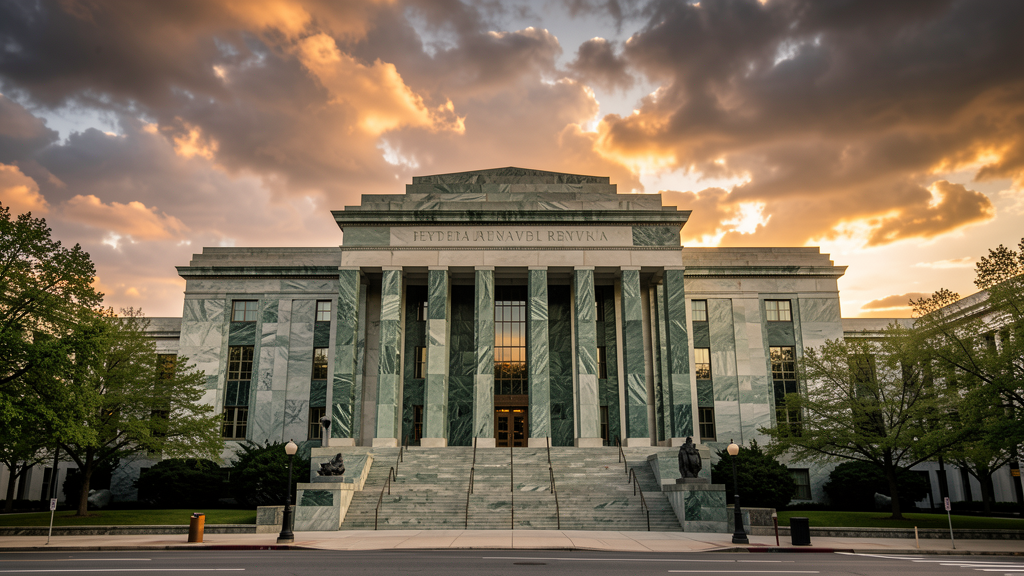
The Federal Reserve held its benchmark interest rate steady at 3.5 to 3.75 percent on June 17 in its first meeting under new Chair Kevin Warsh. The decision was unanimous. The message it carried about where rates are headed was anything but.
The June FOMC statement is 130 words long — down from 341 in April. Warsh, a noted critic of Fed overcommunication, removed all forward-guidance language and cut to what he described as "the facts." Gone is the prior bias toward rate cuts. The new statement simply notes that inflation remains elevated relative to the 2 percent goal and that the Committee will "deliver price stability." The unanimity that produced the new language was itself a shift: three regional presidents dissented over guidance in April.
The real story is in the new "dot plot," the anonymous participant projections released alongside the decision. Median expectation for year-end 2026 is now 3.8 percent — a quarter-point higher than the 3.75 percent current range and up from 3.4 percent in March. That shift means the committee's midpoint expectation now includes at least one rate increase before December. The participant split is nearly even: eight expect no change, one expects a cut, and nine expect at least one hike. Painfully close.
Warsh did not submit a dot himself. He told reporters afterward that he did not find the exercise "helpful in the conduct of policy" and said he would lead a year-end review of the Fed's broader communication apparatus — including whether the dot plot, press conferences, meeting minutes, and transcripts should be restructured. He left the door open to substantive change by end of year.
The inflation backdrop explains the shift. May 2026 data showed annual headline inflation at 4.2 percent — its fastest pace since April 2023 and the third consecutive monthly acceleration. Core inflation, which strips out volatile food and energy prices, came in at 2.9 percent, in line with consensus. The spread between headline and core inflation, now roughly 130 basis points, is unusually wide. Energy supply shocks, particularly from the ongoing U.S.-Iran military conflict over the Strait of Hormuz, accounted for more than 60 percent of the total monthly CPI increase.
The labor market has so far resisted the inflation impulse. Nonfarm payrolls grew by 172,000 in May, defying expectations of slowing hiring. The unemployment rate has held steady at 4.3 percent for the past 12 months. But the combination of hot inflation, resilient employment, and energy-driven cost pressures has given the Fed's hawkish wing cover to argue that patience is no longer the right strategy.
Markets had already adjusted. The CME Group FedWatch gauge shows traders pricing in roughly one quarter-point rate increase by the end of 2026, with no cuts expected in between. That pricing is consistent with the new median projection but entirely at odds with where markets started the year, when three cuts were the consensus expectation.
The irony is simultaneous. The Fed is explicitly worried about inflation caused by external supply shocks that it cannot directly address through monetary policy, while acknowledging it expects AI adoption to deliver disinflationary productivity gains over a longer horizon that does not help with today's price readings. Warsh himself described AI-driven productivity as a "long-term disinflationary force" — a verdict that may reassure investors with a multi-year view but does nothing for a homeowner with an adjustable-rate mortgage.
Image source: v3b.fal.media