American manufacturing expanded in July at its strongest pace in more than two years, defying persistent concerns that the sector would contract under the weight of high interest rates and uneven consumer demand. The Institute for Supply Management's manufacturing index climbed to 52.8, crossing the threshold that separates growth from contraction for the first time since early 2024.
The reading surprised economists, who had expected a modest decline to 49.5 from June's 50.2. Instead, new orders, production, and employment subindices all improved, suggesting that manufacturers were seeing renewed demand across multiple industries. The new orders index, a closely watched leading indicator, jumped to 55.3 from 51.4, its highest level since before the Federal Reserve began its aggressive rate-hiking campaign in 2022.
The manufacturing rebound appears to be driven by a confluence of factors. Reshoring initiatives launched during the Biden administration have begun to translate into actual capital expenditure, with domestic semiconductor fabrication plants, battery factories, and automotive assembly lines moving from planning to construction. The CHIPS and Science Act, passed in 2022, has directed more than $200 billion in public and private investment toward domestic manufacturing capacity.
"We're seeing the early fruits of a multi-year industrial policy," said Ian Shepherdson, chief economist at Pantheon Macroeconomics. "These projects have long lead times, but the capital is now hitting the ground, and it's creating demand for construction materials, industrial equipment, and specialized labor that ripples through the supply chain."
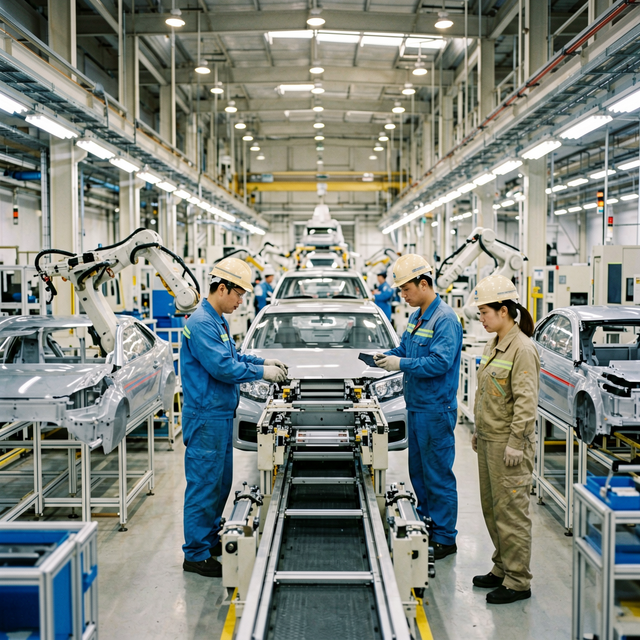
The automotive sector was a notable bright spot. Electric vehicle production lines at Ford's BlueOval City complex in Tennessee and General Motors' Ultium facilities in Ohio and Michigan ramped up output during July, contributing to a 3.2 percent month-over-month increase in motor vehicle assemblies. Tesla's Gigafactory in Texas also reported record weekly production rates for its Model Y and Cybertruck lines, according to internal communications reviewed by Reuters.
Labor market data within the manufacturing sector showed signs of tightening. The ISM employment index rose to 51.2, indicating that factories were adding workers after months of flat or declining headcounts. Average hourly earnings for production and nonsupervisory employees in manufacturing increased 0.5 percent in July, outpacing the 0.3 percent gain for the private sector as a whole. Manufacturers reported particular difficulty hiring skilled trades workers, machinists, and semiconductor technicians.
Supply chain conditions continued to normalize. The ISM supplier deliveries index fell to 48.9, indicating that materials were arriving faster than in previous months, a reversal from the severe shortages that plagued manufacturers during 2021 and 2022. Input price pressures remained modest, with the prices paid index holding steady at 54.3, well below the levels that stoked inflation fears in 2022.
The manufacturing data provided a counterpoint to recession fears that had flared in June after a weaker-than-expected gross domestic product report. While manufacturing accounts for only about 11 percent of U.S. economic output, its cyclical sensitivity makes it an important barometer of broader business confidence. The July expansion suggests that corporate investment plans remain intact despite elevated borrowing costs.
Regional Federal Reserve manufacturing surveys released August 4 and 5 painted a mixed but generally improving picture. The Philadelphia Fed's index rose to its highest level since November 2024, while the Dallas Fed's Texas manufacturing survey showed continued expansion in the energy-heavy region. The New York Fed's Empire State index, however, slipped into contraction territory, dragged down by weakness in apparel and textiles.
Image source: i.ibb.co