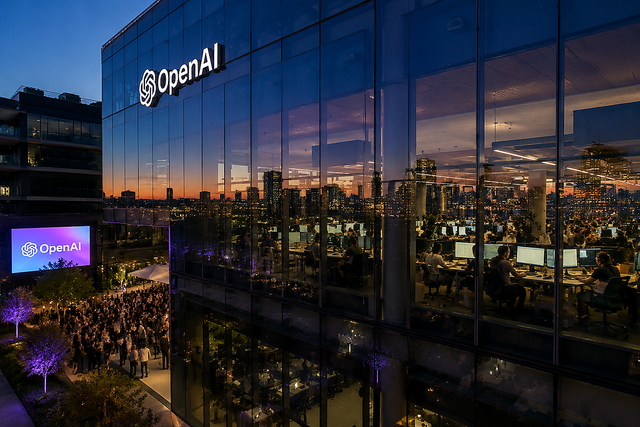
OpenAI on Wednesday launched ChatGPT Work, a long-awaited "super app" that consolidates coding tools, autonomous agents, and enterprise workflows into a single interface, marking the company's most aggressive move yet to reclaim momentum in the intensifying race against Anthropic for corporate AI customers.
The product, which had been in development for more than a year under the internal codename "Frontier," merges ChatGPT's conversational capabilities with Codex, OpenAI's coding platform, and a suite of AI agents capable of browsing the web, executing code, and managing multi-step tasks without human intervention. Company executives described the launch as a fundamental rethinking of what an AI assistant should be.
"Chat is dead," said Thibault Sottiaux, OpenAI's head of core product and platform, during a press briefing. "What we're building is a personal agent that is capable of helping you across everything in your life, be it personally or at work." The comment echoed internal messaging first reported by the Financial Times in June, when OpenAI's super app ambitions began to take shape publicly.
The launch comes at a critical juncture for the San Francisco-based company. Anthropic has made significant inroads into the enterprise market in recent months, particularly after the US government partially lifted export controls on its Claude Fable 5 and Mythos models, restoring access for more than 100 trusted organizations. Anthropic's Claude Sonnet 5, released in late June, has been positioned as a cheaper alternative for agentic work, further squeezing OpenAI's market position.
ChatGPT Work introduces tiered pricing that routes simpler tasks to lighter, less expensive models while reserving OpenAI's most powerful frontier systems for complex reasoning and coding challenges. The approach mirrors a broader industry shift toward cost-conscious AI deployment, driven by enterprises that have found usage-based pricing models unpredictable as workloads grow more sophisticated.
The product also reflects OpenAI's effort to build a sustainable business ahead of a planned public offering. The company has been burning through billions in cash as it scales its infrastructure, and converting free ChatGPT users into paying enterprise customers is widely seen as essential to reaching profitability. OpenAI recently raised its revenue forecast for 2026, though it still expects to post a significant operating loss.
Industry analysts noted that the super app strategy carries risks. By consolidating multiple products into one interface, OpenAI is betting that users prefer a unified experience over specialized tools — a bet that has not always paid off in the technology sector. Microsoft's attempts to bundle AI features across its Office suite have received mixed reviews, with some enterprise customers complaining about feature bloat and inconsistent performance.
Still, the launch drew immediate interest from enterprise buyers. Several Fortune 500 companies that had been evaluating Anthropic's offerings said they would take a fresh look at OpenAI's platform now that coding, agents, and conversational AI are integrated into a single product. The true test will come in the months ahead as organizations decide which vendor's ecosystem best fits their workflows — and their budgets.
Image source: i.ibb.co